All posts by Scottish Raptor Monitoring Coordinator

Scottish Raptor Issue 33 – Meet the New Scottish Raptor Monitoring Coordinator

As you may be aware, I (Bethany) started as the new Scottish Raptor Monitoring Coordinator (SRMC) in August, replacing Gaby Peniche who has moved on to fresh pastures. I have come into the role having recently been employed by the RSPB as a Research Assistant for the national Merlin survey, which many of you will have also participated in. Surveying Merlins is a test in patience and perseverance, with many long hours spent roaming bog and moorland in search of these inconspicuous falcons. I was lucky enough to be allocated hectads to survey in the Flow Country and around the north coast. In addition to recording Merlins, I had some amazing views of other raptors as well as waders, passerines, moths, butterflies, dragonflies and bog specialist plants. I logged most of my survey days on Strava, and walked a total of 728km across the four months… There is some relief in being able to rest my legs as I get stuck into my new position with the BTO.

Before working on the Merlin survey, I was a Ranger and Guide at Aigas Field Centre, near Beauly, taking guests across the Highlands looking for wildlife and teaching them about Scotland’s species, ecology and conservation. In my spare time, I love birding (of course!), cetacean spotting, snorkelling, knitting and playing the fiddle. I’m from the Isle of Arran, and love to go back and visit when I get the chance!

I’m really looking forward to working with and learning from all of the dedicated raptor workers and volunteers who study and monitor Scotland’s birds of prey as part of SRMS. It has been great to meet some of you already, and no doubt I will put more faces to names and email addresses as I settle into the role.

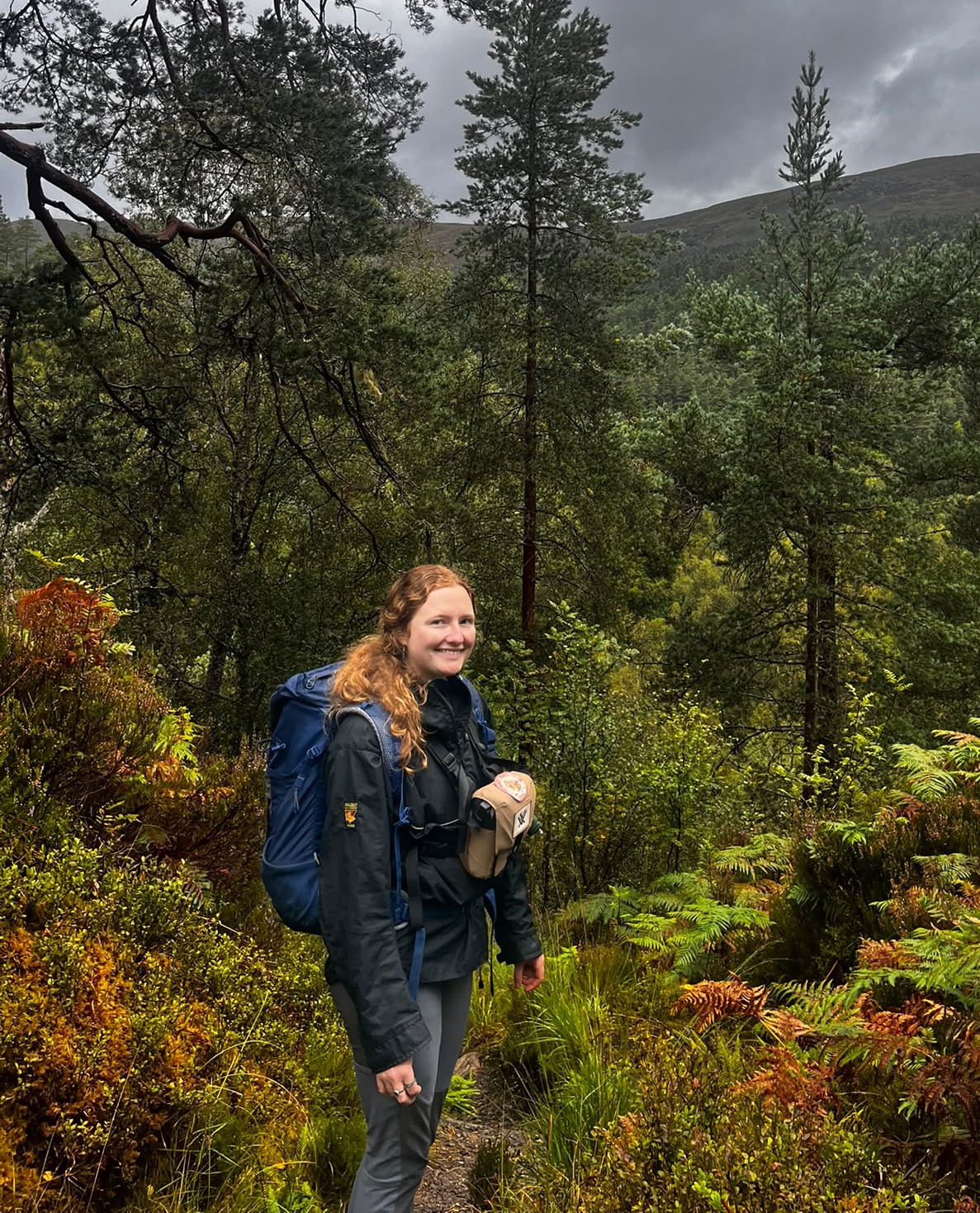
Bethany in the Scots Pinewoods of Glen Affric
Bethany Walsh, Scottish Raptor Monitoring Coordinator

Scottish Raptor Issue 33 – Updates from SRMG

The Scottish Raptor Monitoring Group (SRMG), which is the steering group for the Scottish Raptor Monitoring Scheme (SRMS), met on Tuesday 22nd September. Many biscuits were consumed!

At the meeting, Andrew Stevenson handed over Chairperson duties to David Stroud. Andrew will continue to represent NatureScot on SRMG. We are hugely grateful for the time and effort Andrew has put into the scheme during his 16 years as Chairperson and are delighted to welcome David to the role. David has decades of experience in ornithology and conservation, and was involved in the establishment of SRMS and in SRMG through his role at JNCC, who were formerly a partner.

The BTO also recently said goodbye to Chris Wernham, who has retired as Head of BTO Scotland. Chris was integral to the establishment and continuity of SRMS as well as developing methodologies for surveying British raptors and representing the BTO on SRMG. We are sad to see Chris go but rest assured that she’ll still be around in birding circles and through her role as Vice-President of Birding and Science on the Scottish Ornithologists’ Club’s Council. Thank you, Chris, for your contributions to the conservation of Scottish raptors.

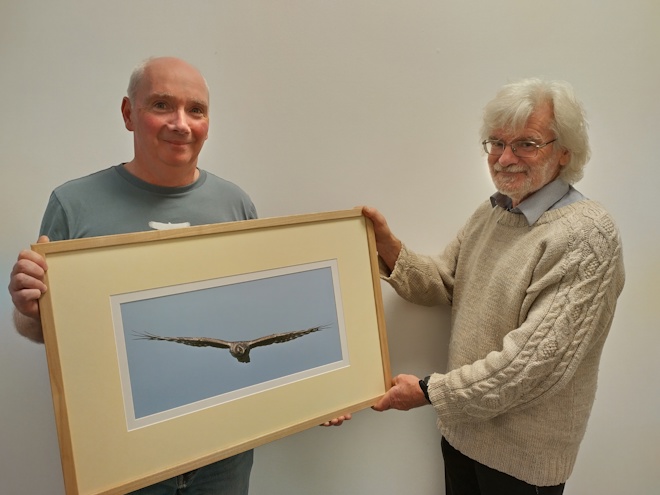
David Stroud handing Andrew Stevenson a framed photo of a hen harrier, taken by Ian Poxton, as a gift from SRMG to say thank you for all of the time and effort he has given to SRMS as Chairperson.
New Chairperson of SRMG, David Stroud handing former Chairperson, Andrew Stevenson a framed photo of a hen harrier, taken by Ian Poxton, as a gift from SRMG to say thank you for all of the time and effort he has put into SRMS as Chairperson.

Scottish Raptor Issue 33 – Recent Publications

Please note that this article contains links to external webpages and articles, for which SRMS is not responsible.


Arcilla, N. & Di Lecce, I. (2026) Migratory connectivity of Palearctic raptors in West Africa: investigating links between wintering and breeding areas and conservation implications through ringing encounters. Environmental and Experimental Biology, 24(1). https://doi.org/10.22364/eeb.24.11.

Chandler, C.J., Hosie, C., Fielding, A.H., Whitefield, D.P., Anderson, D., and Geary, M. (2026) Forest cover influences the movement and behaviour of GPS-tagged Golden Eagle (Aquila chrysaetos): insights from flight characteristics and perch site selection. Ibis. https://doi.org/10.1111/ibi.70117.

Corregidor-Castro, A., Berlusconi, A., Cecere, J.G., Cioccarelli, S., Battisti, C.D., Romano, A., Rubolini, D., Pilastro, A. and Morganti, M. (2026) Shelters or ecological traps? Context-dependent effects of nestboxes on breeding success in a colonial raptor. Ibis. https://doi.org/10.1111/ibi.70049.

Gallego-García, D., Orozco-Valor, P.M., Martínez-Miranzo, B., Gómez-Espí, S. & Sarasola, J.H. (2026) A hundred birds or more: Large-scale assessment of raptor electrocutions across Argentina. Perspectives in Ecology and Conservation, 24(3), 299-305. https://doi.org/10.1016/j.pecon.2026.02.015.

Glucs, Z.E,  Hunt, W.G., Kilpatrick, A.M., Ambrosini, J., Armstrong, D.J., Bell, D.A., Bianchi, J., Doell, S., Doniach, H., Dudek, B.M., Dunlop, N., Emmons, G., Gregoire, D., Gregoire, A., Lewis, A., Lewis, J., Malec, M., Martin, S., Michel, L., Peck, D.F., Stewart, G.R., Stroshane, T., Ow, C. & Lyon, B.E. (2026): Rapid decline of nesting Peregrine falcons in the San Francisco Bay region of California synchronous with an outbreak of H5N1 Highly Pathogenic Avian Influenza. Journal of Raptor Research 60(3), 1-11. https://doi.org/10.3356/jrr26022.

Lewis, P., Johnstone, C.P., Chaston, T., Hampton, J.O., Clarke, J., Leeder, J., Wang, Y., Etterson, M., Martin, J., Saaristo, M. (2026) PFAS in Australian raptor species: terrestrial biomonitors of environmental contamination in changing ecosystems. Environmental pollution, 129082. https://doi.org/10.1016/j.envpol.2026.129082.

Liguori, G., Castagna, F., Bava, R., Lapenna, M. M., Ruga, S., Pagano, A., … Lombardi, R. (2026). Raptors as sentinels: unveiling the environmental and health risks of PFAS contamination. Toxicology Mechanisms and Methods, 36(5), 638–651. https://doi.org/10.1080/15376516.2026.2643909.

Maxted, B. C., Stillman, R. A., Gillingham, P. K., Hill, R. A., Mackrill, T., & Dennis, R. (2026) Long-term patterns of breeding range expansion mirror invasion dynamics during recolonisation of a semi-colonial raptor. Journal of Animal Ecology, 00, 1–15. https://doi.org/10.1111/1365-2656.70322.

Mayall, E., Bodey, T., Caplat, P., Anderson, D., Whitfield, D.P. and Lambin, X. (2026) Variation in forest area influences post-fledging development and dispersal onset in the Eurasian Goshawk (Astur gentilis). Ibis. https://doi.org/10.1111/ibi.70095.

Ozturk, R., Adediran, G.A., Brass, D.P., Mills, W.F., Stevens, M., Robinson, A. and Black, S. (2026) Interspecific differences in microplastic accumulation and polymer profiles from regurgitated pellets of coexisting raptors. Environmental Pollution, 405(2026), 128483. https://doi.org/10.1016/j.envpol.2026.128483.

Panter, C.T., Bullock, H.E., Brown, M., Mori, D. & Thompson, L.J. (2026) Taking the pulse of the world’s raptors – A systematic quantitative review of wildlife rehabilitation centre admissions. Biological Conservation, 316, 111746. https://doi.org/10.1016/j.biocon.2026.111746.

Roos, S., Campbell, S.T., Hartley, G., Shore, R.F., Walker, L.A. & Wilson, J.D. (2021) Annual abundance of common Kestrels (Falco tinnunculus) is negatively associated with second generation anticoagulant rodenticides. Ecotoxicology, 30: 560-574. https://doi.org/10.1007/s10646-021-02374-w.

RSPB (2026) Patterns of persecution: a species-based study of the illegal killing of birds of prey in the UK (2015-2024).

Ozaki, S. Barnett, E.A., Carter, H., Chaplow, J.S. Charman, S., Galloway, M., Pereira, M.G., Potter, E., Sainsbury, A.W., Shadbolt, T., Sharp, E.A., Shaw, G., Sleep, D., Walker, L.A., Qassim, S.M. (2026) Probabilistic approach reveals the toxicity threshold values of free-living raptors in Great Britain, United Kingdom, for the lethal effect of second-generation anticoagulant rodenticides. Environment International, Volume 208, 2026, 110099, https://doi.org/10.1016/j.envint.2026.110099.

Wallis, Robert. (2026). Raptorness: the ‘bodies’ of humans becoming-with birds of prey in the art and archaeology of early medieval England. Open Arts Journal. 11-30. https://doi.org/10.5456/issn.2050-3679/2025w01.

Watts, B.D., Clark, K.E. & Hines, C. (2026): The influence of diet-mediated exposure of avian influenza on adult survival, recruitment and territory occupancy in peregrine falcons. Nature Scientific Reports 16, 12821. https://doi.org/10.1038/s41598-026-42721-7.

Whitfield, D. P., B. K. Sandercock, R. Ogden, R. Tingay, and P. Whitfield. (2026) Apparent Survival of Territorial Golden Eagles Using Non-Invasive Genetic Profiling. Ecology and Evolution, 16, no. 1: e72912. https://doi.org/10.1002/ece3.72912.

Scottish Raptor Issue 33 – Raptors in the Media

Haven’t got enough raptors in your life? Here’s some more bird of prey content to enjoy!

Please note that this article contains links to external webpages and articles, for which SRMS is not responsible.

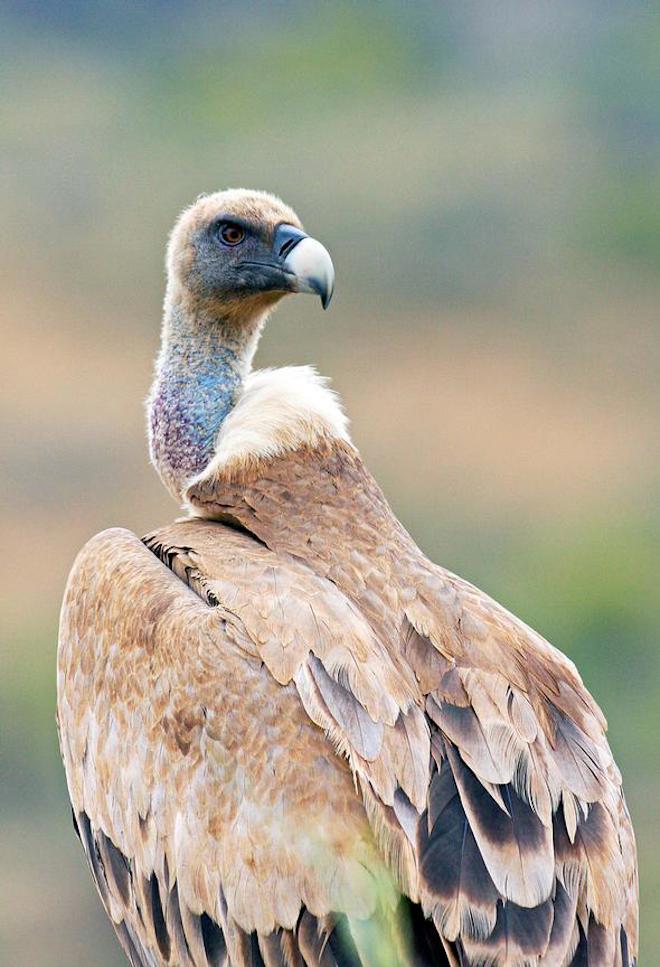
Griffon Vulture, by John Harding / BTO

Scottish Raptor Issue 33 – An Update from the Cairngorms Raptor Project

The Cairngorms raptor project is dedicated to seeing healthy and productive populations of raptors restored within the Cairngorms National Park. It focusses work on the four species (golden eagle, peregrine falcon, hen harrier and merlin) listed as priority species in the National Park Partnership Plan.

The project takes a partnership approach and through engagement with land managers and experts in the field, works to monitor populations, build understanding of the issues facing raptors and eliminate wildlife crime.

Survey work 

Core to the project is good data and evidence. Over time we have been working to build a comprehensive picture of current raptor populations in the National Park, drawing on existing information and filling in gaps with survey and monitoring or modelling. Raptor data will also be used in the Cairngorms Nature Index to tell us about the health and function of our ecosystems, enabling us to target our conservation work, measure progress against national trends, and evaluate success.

The Cairngorms peregrine survey 2024 showed a concerning decline in numbers since 2002. This decline is likely a result of a combination of land management practices, decreased prey availability, wildlife crime and, more recently, outbreaks of avian flu. We are exploring a range of options to address this decline, including GPS tagging to gather data on bird movements and survival. The full report can be found online here.

In 2026, the Park Authority has carried out a survey of breeding merlin to estimate the number of breeding pairs within the Cairngorms National Park, and to provide additional coverage for the national merlin survey. In addition, we’re working to establish how much potential habitat there is for golden eagles and hen harriers in the National Park, allowing us to estimate the potential size of the population the Park could support.

Tagging 

Working with the North East Scotland Raptor Study Group, we fitted three golden eagle chicks with satellite tags in 2025 and a further eight chicks with GPS tags in 2026. The tags give valuable insights into the behaviour, movements, and habitat usage of juvenile eagles in the changing landscape of the Cairngorms. The data from the tags are shared with the national dataset, building understanding of this species and contributing to a comprehensive picture of golden eagles in Scotland. Next year we will work with partners to fit a further four eagles in the National Park with GPS tags.

The Park Authority is progressing tagging of other priority raptor species and has funded the purchase of satellite tags to be used by the RSPB. These are being fitted to hen harriers within the National Park over the next two breeding seasons, tracking individual birds’ movements to further inform scientific understanding of the ecology of the species. We are also supporting a trial of peregrine tagging through the purchase of GPS tags to be used by Lothian and Borders Raptor Study Group and Tayside and Fife Raptor Study Group.

Tackling wildlife crime

Unacceptably, raptor persecution is still happening in and around the National Park. The Park Authority actively supports the detection of crimes against birds of prey in the National Park through data sharing, and works with the Raptor Persecution Tactical Delivery Group, led by Police Scotland to eliminate wildlife crime.

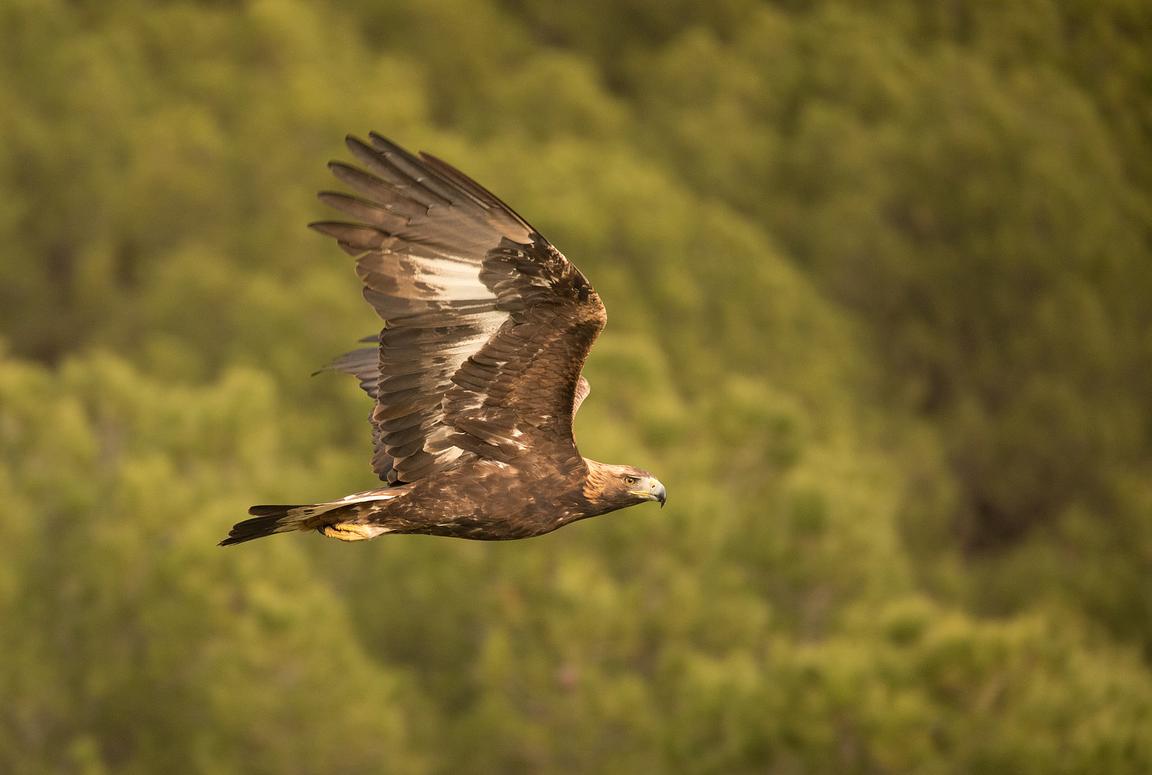
Golden Eagle by Liz Cutting / BTO


By Isla Graham, Raptor Conservation Officer at the Cairngorms National Park Authority

2024 Annual Report Published

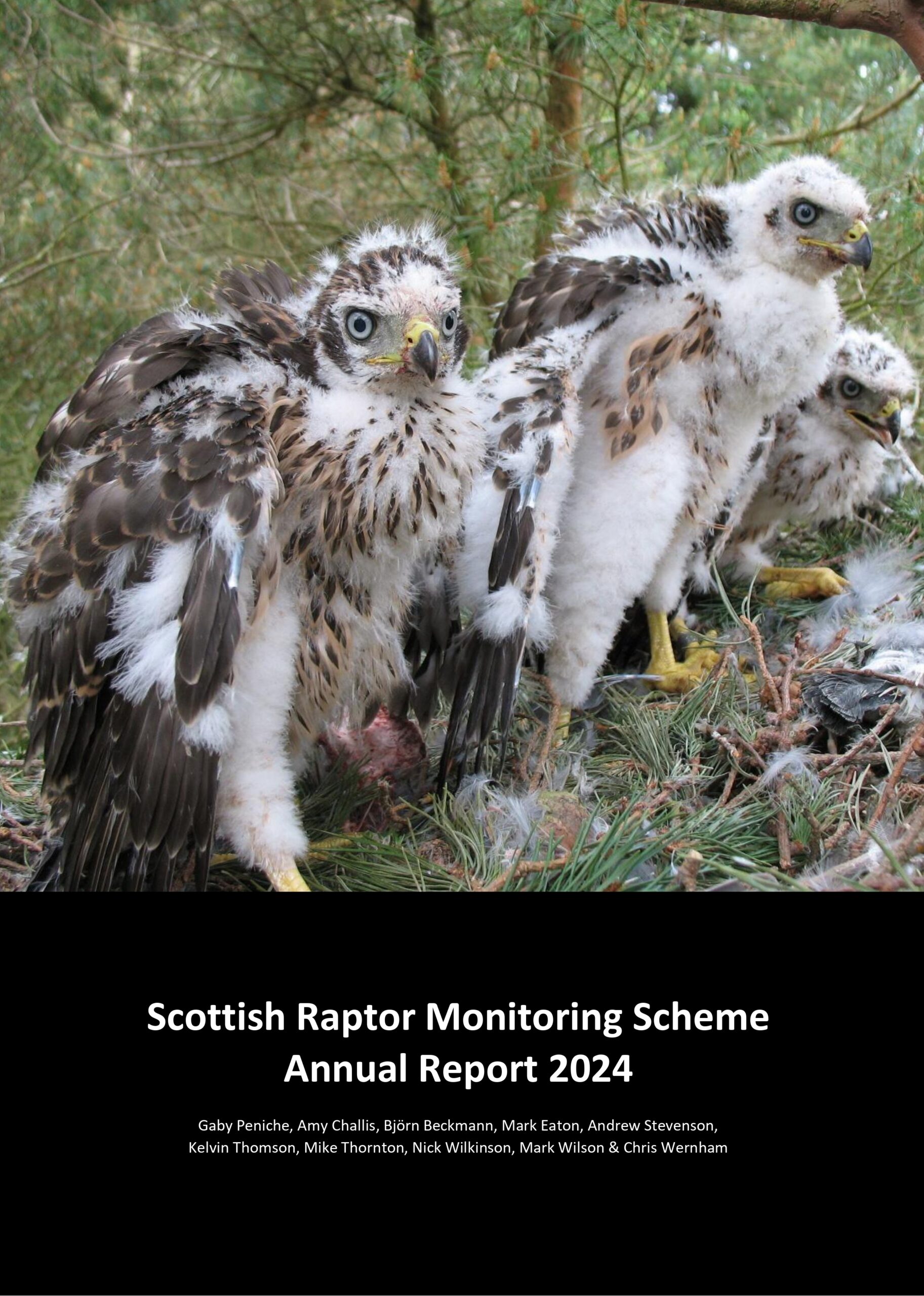
The 2024 Annual Report of the Scottish Raptor Monitoring Scheme (SMRS) has now been published and can be accessed here, along with previous reports.

Thank you to all those who continue to collect and submit raptor monitoring data to SRMS. Your efforts are hugely appreciated.

Photo: M. Henderson (SRSG). Authors: Peniche, G., Challis, A., Beckmann, B., Eaton, M., Stevenson, A., Thomson, K., Thornton, M., Wilkinson, N., Wilson, M. & Wernham, C. 2026. Scottish Raptor Monitoring Scheme Report 2024. BTO Scotland, Stirling.


Scottish Raptor- April 2026

The latest issue of Scottish Raptor is now available. Please take a look here to find out all the news from the Scottish Raptor Monitoring Scheme including how  you can take part in our data contributor survey. You can also find out more about our hot-off-the-press improvements to our online data entry system – SRMS Online.

If you would like to sign up to receive future issues of the newsletter by email then please email the SRMS – [email protected].

Back issues of Scottish Raptor can be accessed here.

Scottish Raptor- December 2025


The latest issue of Scottish Raptor is now available. Please take a look here to find out all the news from the Scottish Raptor Monitoring Scheme including how  you can take part in our data contributor survey. You can also find out more about our hot-off-the-press improvements to our online data entry system – SRMS Online.

If you would like to sign up to receive future issues of the newsletter by email then please email the SRMS – [email protected].

Back issues of Scottish Raptor can be accessed here.

SRMS 2023 Annual Report Published


Photo: G. Peniche (SRSG). Authors: Peniche, G., Challis, A., Beckmann, B., Wilson, M., Eaton, M., Stevenson, A., Stirling-Aird, P., Thornton, M. & Wilkinson, N. (2025). Scottish Raptor Monitoring Scheme Report 2023. BTO Scotland, Stirling.

The SRMS 2023 annual report is here and in it you can find information about breeding populations of Scottish raptors in 2023. You can access the report here  along with supplementary data tables.


Scottish Raptor – June 2025

The latest issue of Scottish Raptor is now available. Please take a look here to find out all the news from the Scottish Raptor Monitoring Scheme including how you can help or get involved in various raptor projects.

If you would like to sign up to receive future issues of the newsletter by email then please email the SRMS – [email protected].

Back issues of Scottish Raptor can be accessed here.